
On the weekend of the 26th and 27th April, I took part in the Kenya Space Weekend, which was organised by Andrew Gakiria with his Kenya eLearning Center and The Outpost, Oloshoibor, Kajiado, and partnering with DarkSky Kenya and the Space Society of Kenya (SSK). I’m a member in the latter two.
The location was Eluai Greens Resort, just at the foot of Ngong Hills on the Rift Valley side. The Resort is part of “The Outpost”, which is a partnership of several organisations and sites in Kajiado, hosting different kinds of activities and events.
I had previously travelled along the road leading to the resort, but had never quite stopped to take in the view of the hills from that side. Which look quite a bit more imposing from down in the valley than from the Ngong/Nairobi side, from which we usually see them:
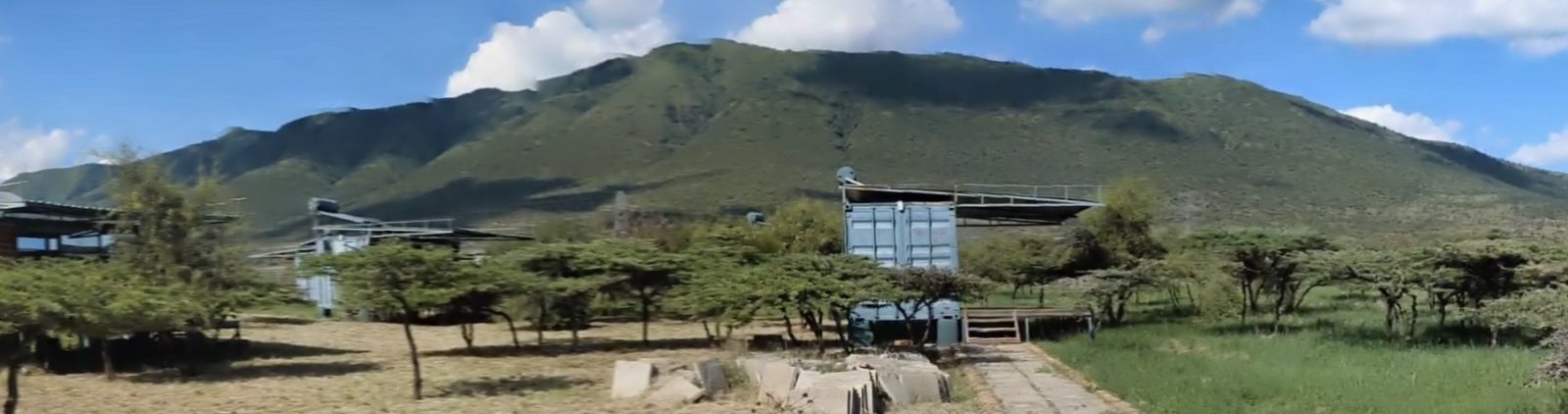
The Space Weekend was carried out as part of the International Dark Sky Week, which is held each year to create awareness for the preservation of the dark night sky, and which hopefully inspires people to turn their lights off. This always happens around New Moon in April, which isn’t actually all that great for Kenya because it’s in the middle of our rainy season. However this time, we were lucky and the clouds mostly cleared during the night, and there was no rain. Next year, we might therefore move the event to another time.
So in front of the above view, we set up the various telescopes that we brought:
- Francis’ Turkanascope, which I had recently reviewed here, an 8″ Dobsonian,
- SSK’s 6″ Newtonian on a manual EQ mount (donated by Ben Roberts),
- My 6″ table-top Dobsonian (SkyWatcher Heritage 150p), remounted on a motorised EQ mount,
- My 65mm f/6.5 short tube refractor, which I mostly use as an astrograph, but which I mounted on the table-top Dob mount from the 150p for this occasion, and put on a chair for easy access by the various small children that were in attendance, and
- SSK’s and my own pairs of 10×50 binoculars, mine mounted on tripod.
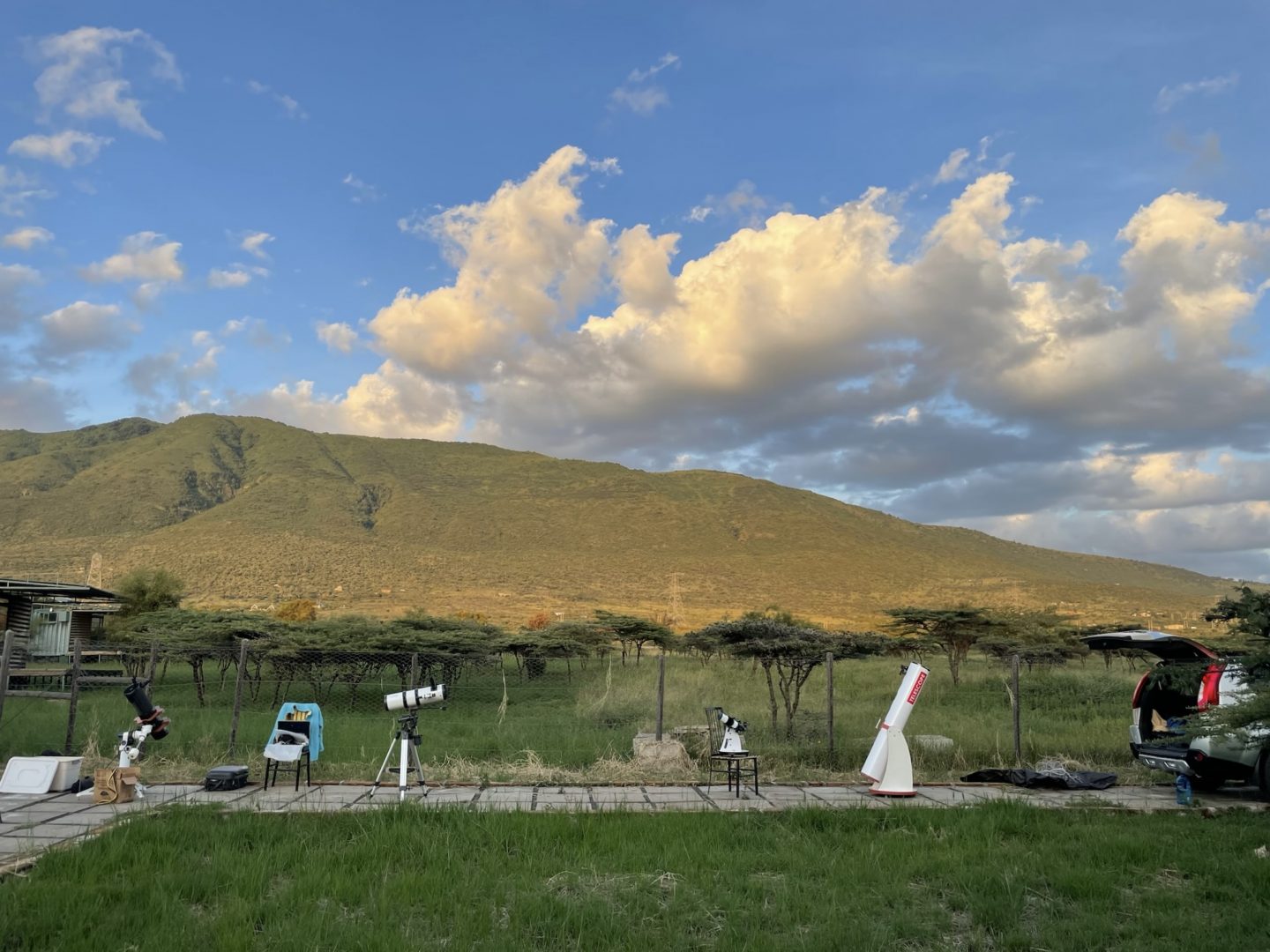
Here’s Bram, SSK’s founder and chairman, showing the Turkanascope a bit closer:
After the Sun set, it darkened swiftly, as it always happens being near the equator. With almost completely clear skies, we were in for some good night sky watching. We had a mixed audience, with a good number of kids as well. As always, it was great to show the nightly wonders to people, many of whom had never looked through a telescope before.
For a start, we looked at Jupiter and its moons, comparing views through the different scopes. We also had some good views of Orion Nebula, one of the brightest nebulae visible from Earth, and always a great showcase deep sky object (DSO).
Later, we turned mostly southwards, as in the North East, Nairobi’s light pollution loomed over Ngong Hills. An interesting phenomenon to see was that clouds were hanging over the top of the hills the entire night, but thankfully they stayed there. Straight to the North and North West, there also was some light from other settlements and towns, such as Mai Mahiu.
However, the view to the South was clear, and the Milky Way was coming up there in the constellations of Carina, the Southern Cross, and later Scorpius and Sagittarius. We saw Carina Nebula, the Wishing Well Cluster, Omega Centauri globular cluster, M4 + NGC6144 globular clusters in the same view as the bright red star Antares (the “anti-Ares”, or “anti-Mars”), Centaurus A and Southern Pinwheel galaxies, Lagoon Nebula, and others.
Some weeks ago, I had reviewed the Turkanascope and noted some issues with the optics, which however should all be fixable with some effort. But it should be said that it still provided very nice views, especially of Omega Centauri, where it showed a clear “graininess”, indicating that the cluster is composed of millions of stars. It was also the scope with the biggest aperture, and therefore showed the brightest images.
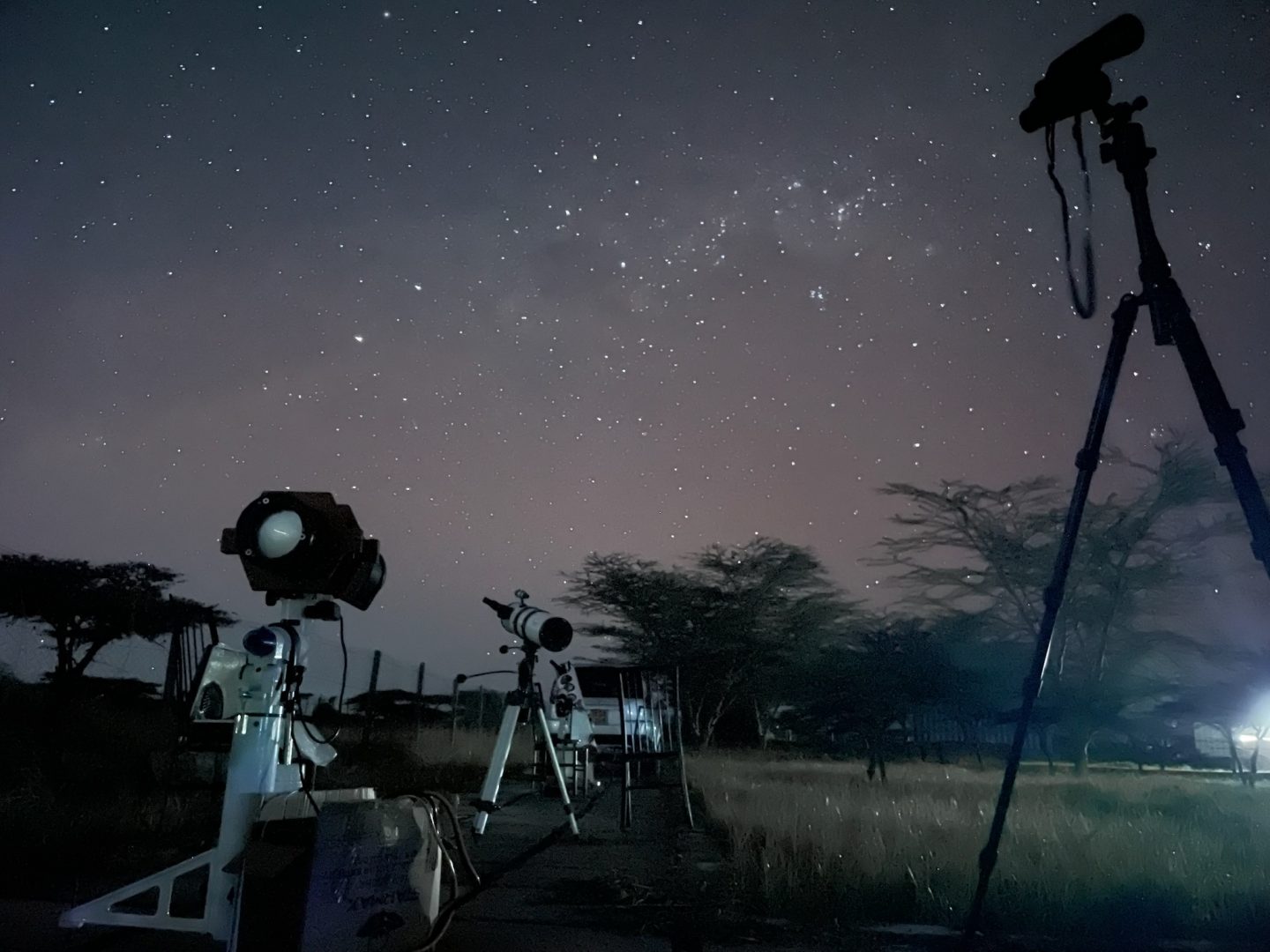
All in all, a great night with a great audience. Andrew took great care of everybody and was working the whole night to accommodate everyone, which I greatly appreciated.
That said, it also became apparent that it is necessary to provide clear instructions for all staff about the nature of the event, and that unnecessary lights and especially flood lights are to be kept turned off for the whole night. The light near the kitchen, which was turned on repeatedly, and whose glare is visible in the picture above on the very right, might have seemed quite far off from where we set up the telescopes — but it was still quite the distraction.
Much better, of course, would be to fix the lights permanently to make them dark sky friendly. DarkSky offers multiple kinds of certifications for this, for different types of locations and lighting setups. It would be awesome to get more sites in Kenya certified, or simply be more aware and do some simple and affordable changes, such as
- turning unnecessary lights off — most “security lights” don’t actually increase security and are unnecessary in the first place,
- not using “solar lights” which cannot be turned off,
- using motion sensors to only turn on lights when someone is moving around,
- pointing lights straight downwards, or shielding them towards the sky, and
- using less bright and “warmer” (“warm white” instead of “daylight”) lights.
The DarkSky website has more info on this topic, and also other motivations why preserving the darkness is important. I’d encourage everybody who’s interested in any of this, in any capacity, to join.
Psalm 19:1-2, NIV:
The heavens declare the glory of God; the skies proclaim the work of his hands.
Day after day they pour forth speech; night after night they reveal knowledge.
…but only if we can actually see what’s in those skies!
Clear — and dark — skies.
I learned that there’s a whole organization – Dark Sky, dedicated to preserving the night sky. Cool!
Light pollution seems like it’s a bigger issue than I initially thought.
Glad to see a locally made telescope in action. I just read your review of the Turkanascope too. I know V2 is around the corner. How can I get one for myself? Does Francis plan to sell? Is the instrument ‘beginner friendly’?
#preservethedarkness
Welcome here and thank you!
To your questions: yes, yes and yes! 🙂
Let me email you Francis‘ contact.
Thank you for the great & informative article. Awesome work with SSK on Dark Skies. Always a great read!!
Thank you Khisa!
Awesome
Thank you Samuel!
This is an awesome article, Bastian thanks for sharing.
Thank you Gideon!
It was an amazing weekend and we were happy to host it as the star gazing, the company, the venue all came together to make it a worthwhile experience. looking forward to the next.
It was indeed, thank you for making this happen!
Many Thanks Bastian for being a very informative and gracious facilitator of the star gazing session!
Participants, especially the children, were so thrilled to finally lay eyes on planets and celestial bodies that only existed in their minds and imagination.
Due to great interest and public demand, we are are planning Kenya Space Weekend 1.0, May 30 to June 2nd 2025, at the OUTPOST, Oloshoibor. To coincide with the long weekend of Madaraka Day Holidays here in Kenya. More details coming up…
See you in Kajiado soon!
Thank you Andrew for running this, and already organising the next one! I’m not sure if I can make it for more than 1 night but looking forward to it!
This is just awesome, already excited for the next one.
Thank you Sein, the next one is already planned, see Gakiria’s comment!