
Last week, we went to Diani Beach for a few days. Apart from all its other attractions, the coast can be quite good in terms of darker skies, though it might often be humid and a little hazy. It was also the time around full Moon, which was on Monday. This would light up the sky for almost the whole night. So conditions for skywatching didn’t promise to be very good overall, and I didn’t go to the trouble of taking my telescope on the train.
My binoculars, on the other hand, are comparatively light and easy to carry. They’re good for various uses during daytime, and at night they can still offer some good views of the Moon, as well as of some of the larger deep sky objects — star clusters, nebulae etc. — during the short time of darkness after twilight ends and before the waning Moon would rise in the evening. Because each day, the Moon rises almost an hour later than on the previous day. At full Moon on Monday, the Moon would rise almost exactly at sunset, at 6:38pm. But on Wednesday night, 2 days later, the Moon would rise at 8:23pm, which would give about an hour of proper darkness.
Apart from that, I was keen to try out the prototype of a new iPhone – eyepiece adapter, that I was recently sent by its creator for testing, some more. It’s called the Turing Mount, and I previously had only very few chances to try it, because of generally cloudy conditions for the last weeks around Nairobi. One very nice feature of it is that its very sleek design allows easy fitting not only on telescope eyepieces, but also on my binoculars1.
Since the coast is facing almost exactly East, it means that the Moon rises right in the middle of the horizon when looking straight out to sea. To catch it while it was coming up, my plan was to set up the adapter with the phone on the binoculars, which were fixed on a lightweight travel tripod that I had also carried. I would then use the object visibility mode of planetarium app Stellarium to point the phone at where the Moon would come up, and start filming just before moonrise.
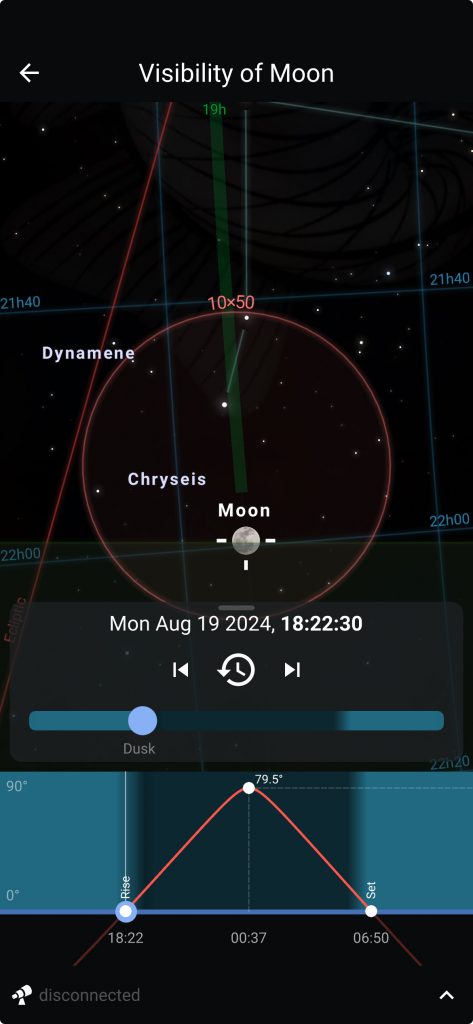
Like all good plans, it wouldn’t exactly work. My phone’s compass wasn’t very exact, and so it was pointing a few degrees off to the South. I realised this only when the Moon had risen already completely above the horizon, as it slowly became easier to see. Because near the horizon, one has to look through a lot more atmosphere (“air masses”) than if looking higher up:

Therefore, very close the horizon, objects are hardly visible at all through all that atmosphere. When I realised the misalignment, I quickly moved the binos over. I recorded until the Moon left the FoV, which happened to coincide with a band of clouds into which the Moon disappeared. Here’s the result, with some time-lapse applied to make it about half a minute long — which just so happened to match one verse of What a Wonderful World by Louis Armstrong. Sometimes, things just fit together 🙃

With that, I’ll leave it here for today, and will write about the mentioned binocular views of deep sky objects in my next post.
Clear skies.
This was quite an exhilarating read.
keep up Bastian , i liked your comment and i quote “Like all good plans, it wouldn’t exactly work.”😂
Just keeping it real 😄
And thank you for the kind words!
This read is amazing. You must have had an awesome time watching the moon. Good job on documenting the experience
Thank you! And yes indeed, it was fun and exciting!
[…] trip to Suswa, about which I’m going to write soon — I finally get around to the promised post about viewing deep sky objects with binoculars, and shooting some pics through them with a […]