
Last weekend, we went to the Olorgesailie Prehistoric Site in Kajiado, where fossilised skeletons and early stone tools some hundreds of thousand of years old have been found. Our traveling party was comprised of my family, and our friend Shirley, an astrophysics master student at TU Kenya. Shirley had run the UoN AstroNight last year, and had then invited me to my first talk there.
Apart from being interesting in an of itself, and situated in one of many spectacular volcanic landscapes in the Great Rift Valley, Olorgesailie made for some fantastic skywatching at night from the attached camp site. It’s also very affordable at KSh 300 per person for camping (bring your own tent and equipment, including cooker etc.) for Kenyan Citizens and KSh 200 for kids (KSh 400 for residents).
The weather was dry and transparency was good. Clouds, which provided some convenient shade during the day — it’s HOT there! — cleared just in time for sunset. Except for a single security light some 5 kms away, and some “normal” lights from a small settlement in the distance, it was very dark the whole night, being just after New Moon.
Compared with another site just behind Mt. Suswa, where we had gone in September with a few members of the newly founded Kenya Space Society, it was quite a bit better, especially less humid (although they had said there that it would become drier in October). This is despite being at lower elevation, at about 1000m compared to about 1600m.
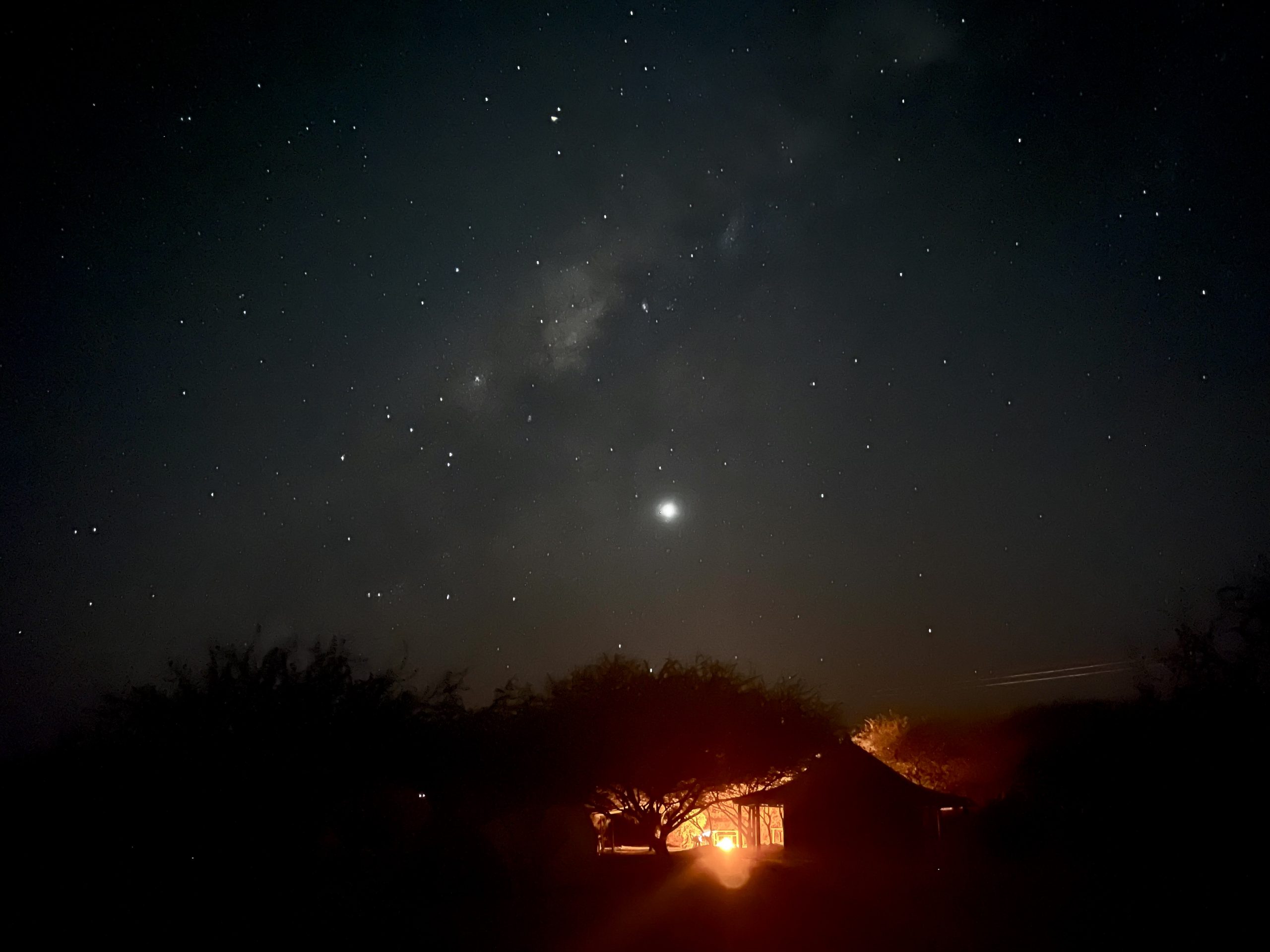
In any case, we had a great night under the sky, with a great number of astronomical showpieces being easily visible with the unaided eye, and giving some spectacular views in binoculars and the telescope as well.
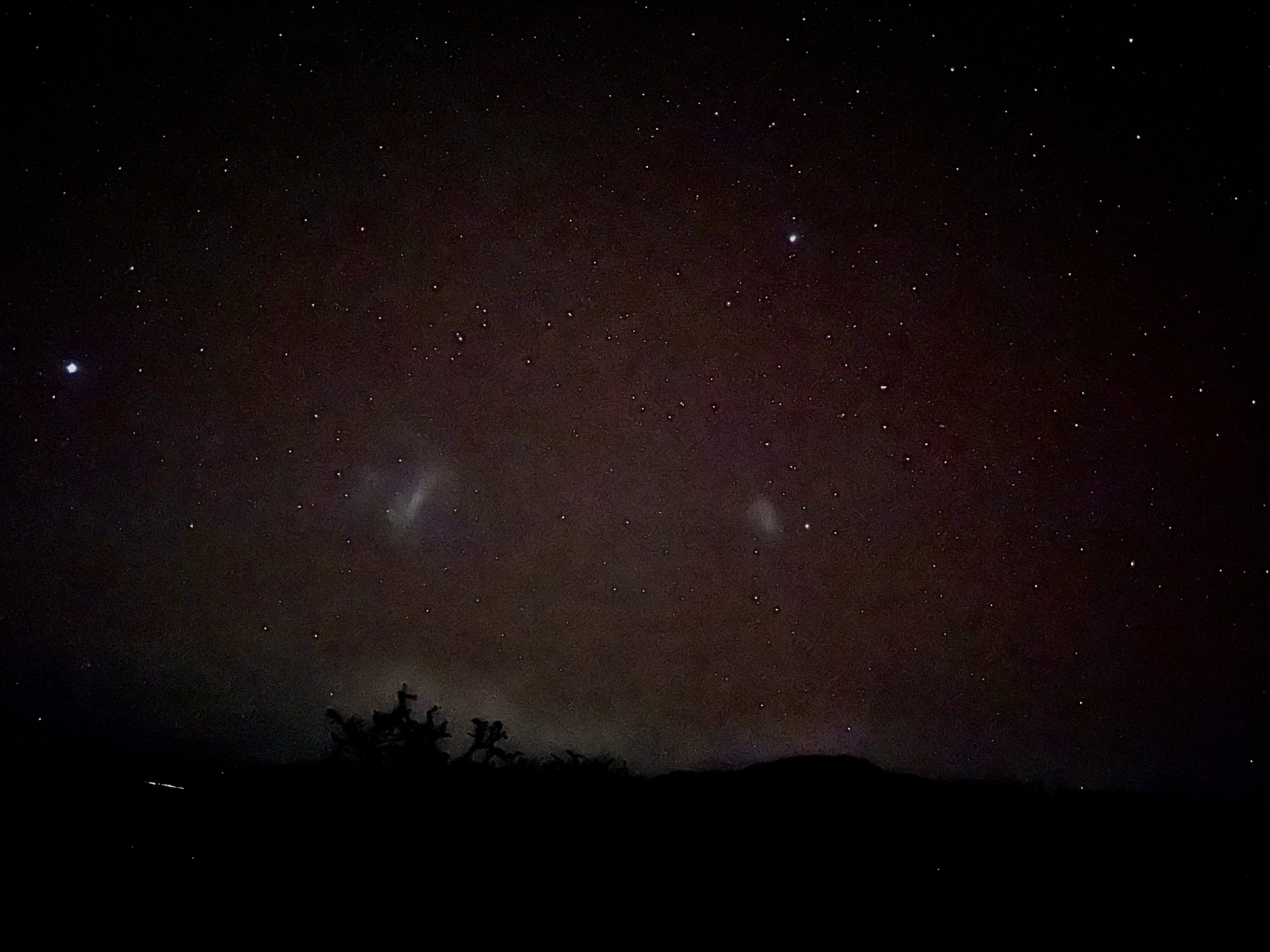
All the following photos were taken with my iPhone (12Pro), on a tripod, with long exposures with the photos app or with the AstroShader app.
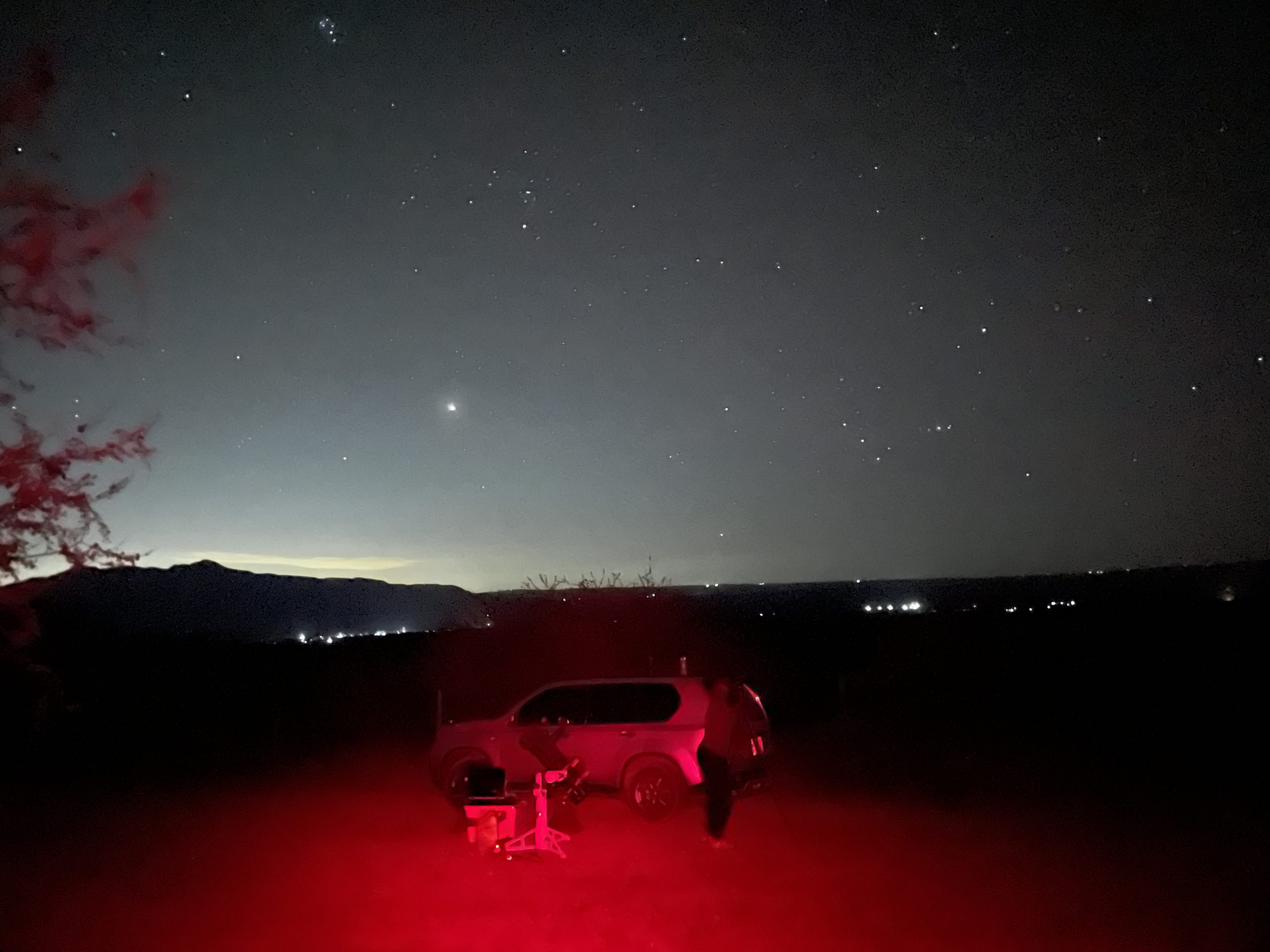
Meanwhile, the camera is looking due East, where we can see Jupiter and Orion rising. Further up in the image are the Pleiades and Hyades open star clusters.
Also visible is the sky glow of Nairobi behind Mount Olesekut; it looks quite a bit stronger in this image than it looked for real there. Giving just a subtle glow to the silhouette of the mountain, it actually looked pretty cool.
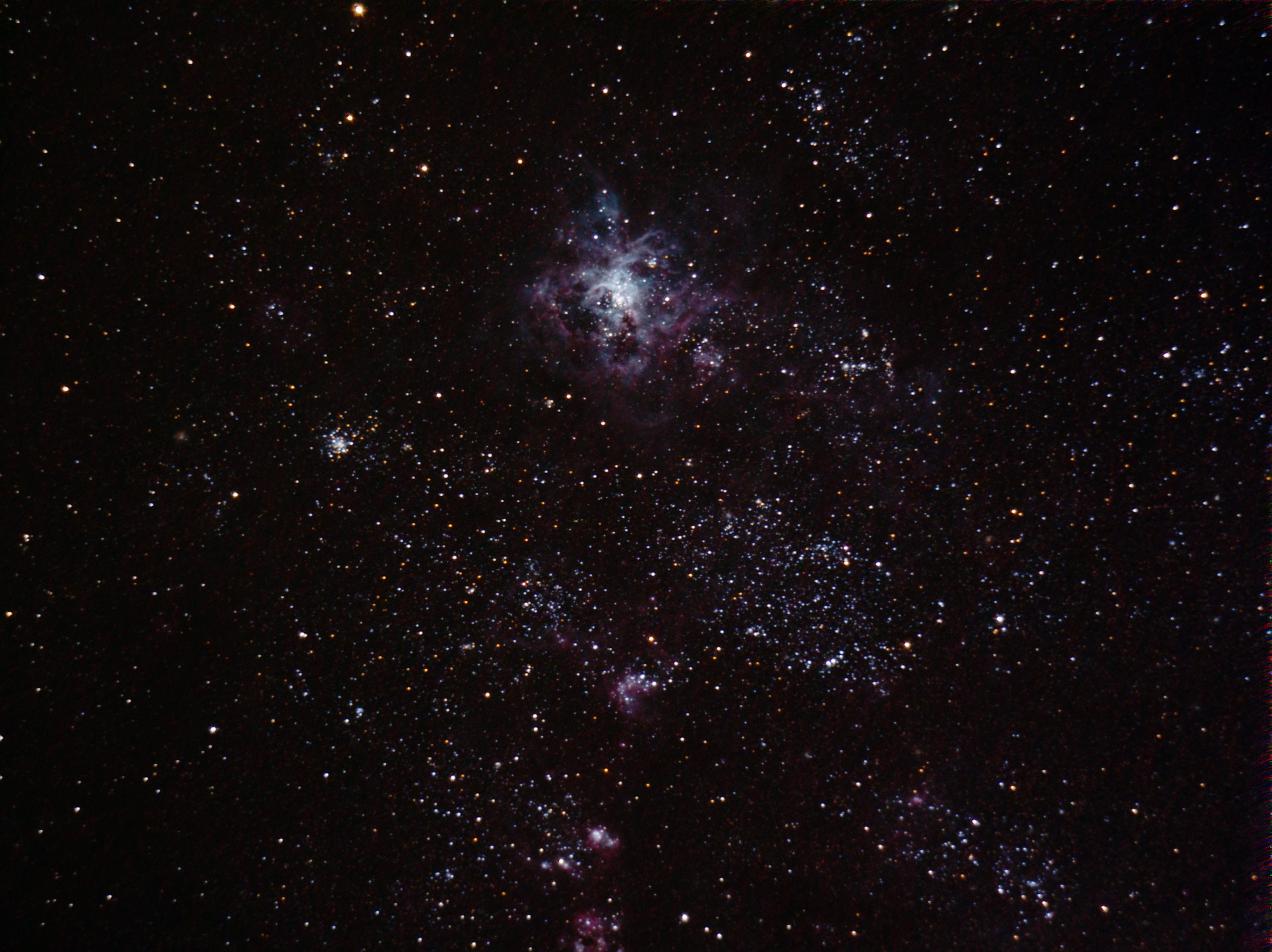
At around 2am, I set up the camera on the telescope to shoot the Tarantula Nebula in the LMC, and spent more time just watching with and without the binoculars until 3am, when the LMC passed the Meridian — i.e. it crossed from the Eastern to the Western celestial hemisphere — and my software would make my German Equatorial Mount perform a “meridian flip”, meaning that it would switch the sides of the arm which carries the telescope on one side and the counterweight on the other. This is to prevent the telescope getting too low on the mount and potentially hitting the pier. In any case, after large mount movements like this, one needs to adjust the camera focus, and I don’t have an automatic focuser. So my plan was to wait until that point and then call it a night…
…but then I noticed that Carina and “its” part of the Milky Way were just rising, giving another great view together with the LMC:
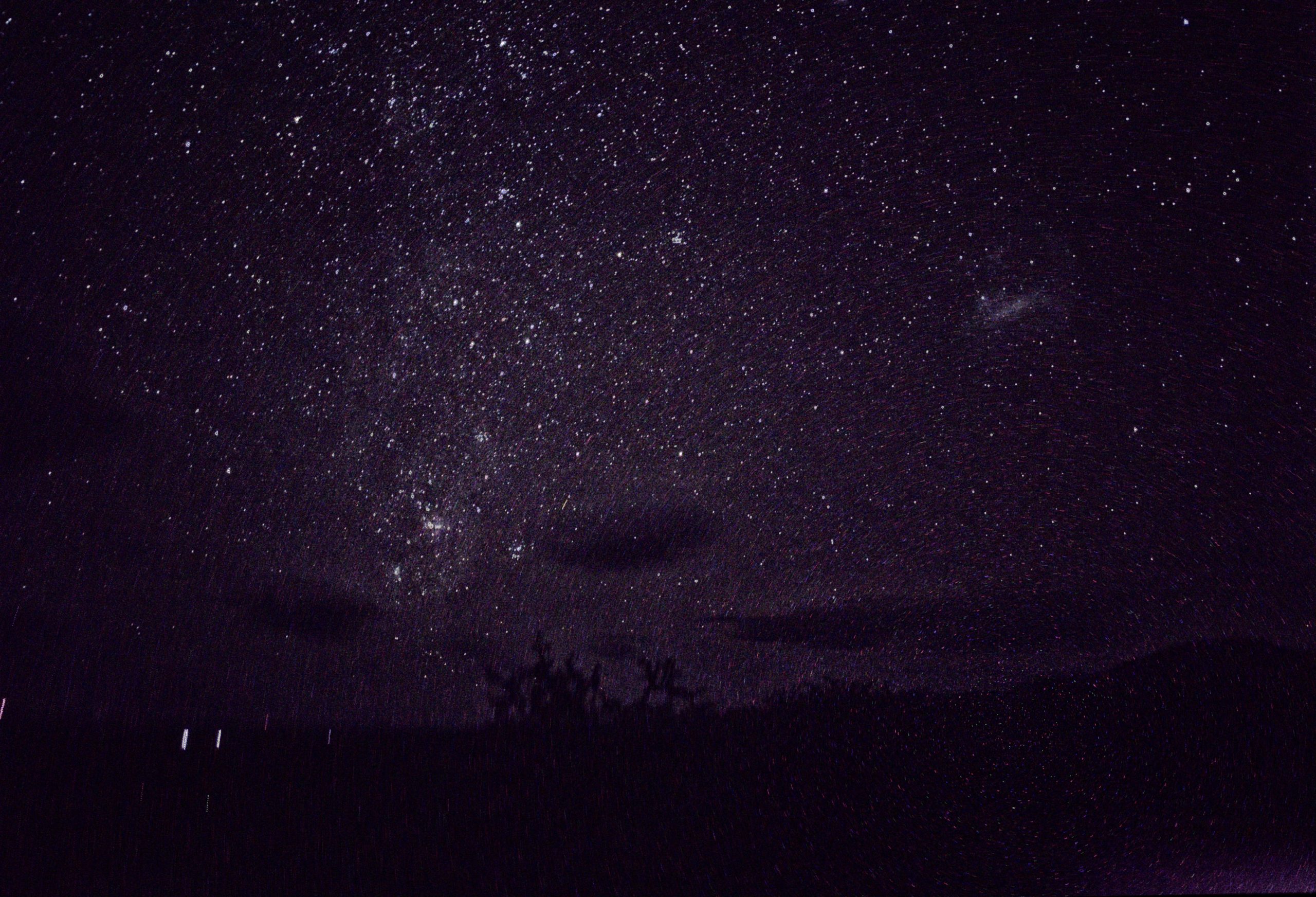
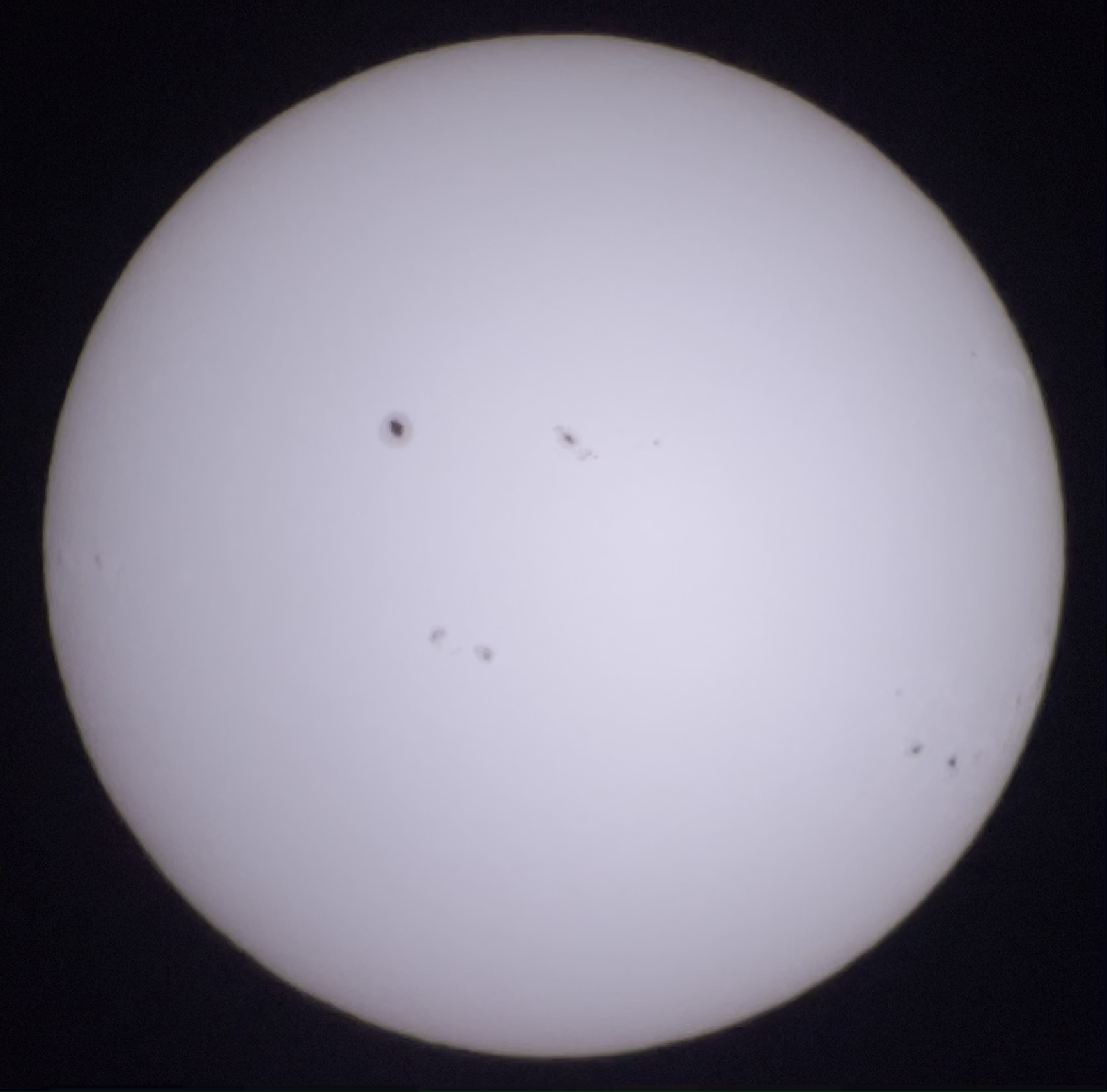
So I stayed up another hour or so to look at that. Then I just left my telescope + camera shooting on, while finally getting some sleep until not long after sunrise, when it gets hot in the tent really quickly. Of course we had to look at the Sun (with a proper Sun filter, never look at the Sun without one!) as well, which was showing numerous Sunspots.
Then, a few days later, I finally got around to processing the shoot of the Tarantula Nebula, using my usual software suite of Siril and Gimp, and this is the result:
To conclude, I think I have found my new favourite skywatching site, which is reachable within about 2 hours from our home. Then again, I heard from a colleague that the road further on to Lake Magadi is very good, so maybe going a bit further out is better still. Though elevation gets lower there, towards 800m. Or even going on to the Shompole Conservancy on the Tanzanian border, though from Magadi it’s a rough road, adding considerable travel time…
So long, clear skies!
WOW. The beauty of God. The stars display His glory.
Amen to that!
Splendid!✨ in one word…!
Thank you. Looking very forward to the next trip, hopefully we can organise a joint one!
This has to be my best skywatching night so far. It was amazing how much we could see with the naked eye and there were quite a number of shooting stars which added to the list. My favourite scenes were seeing the magellanic clouds (LMC & SMC) with the naked eye and the orion nebula through the telescope (i could almost see all the details of it). It was spectacular.
This is a great summary of the night Bastian. Y’all should definitely visit Olorgesailie, it’s a wonderful place (If you ignore the heat and the sunset is worth looking out for too).
Thanks Bastian for including me in your family’s trip.
Thank you Shirley, it was great having you there! Thanks also for reminding me about the shooting stars, I forgot to mention them given the sheer number and quality of things we saw 😁
Quite some amazing shots 📷📷, this is art in itself, beauty in the skies🌌.
Thank you Franc, yes indeed there are many very beautiful things in the sky!
lemme pick me up next time Doc.
💯
Welcome to StarGazersLounge Bastion – those are some grand images too.
One “toy” I am about to buy, particularly for field trips, is the ZWO SeeStar S50 – and it wouldn’t cost more than a few steps on your way to the water tower ;-
Clear Skies,
Tony
Thank you Tony. Yes the S50 has a good reputation, but I also like squeezing the most quality out of available (limited) budget…
Sorry for the auto correction of your name too!
No problem!
Sounded like a spectacular evening of stargazing. Thanks for sharing. We are blessed to be so close to areas with so little light pollution and such expanses of both the northern and southern skies visible.
I’m not sure there’s much to be gained by going further to Magadi or beyond. It’s even hotter and dustier down there. A number of years back I dragged my gear to Magadi only to have it be overcast the entire evening, although I suppose that could happen anywhere.
Hi Dave, yes, we’re blessed indeed! The advantage of Magadi might be that it’s farther from Nairobi. So the skies to the North-East, where one has the Nairobi light dome shining from behind Mt. Olesekut in Olorgesailie, should be theoretically better.
But there’s also that chemical plant in Magadi — is that lit up at night and would have affected your skywatching when you were there, if it had been clear?
[…] been a while since my last post, and I have several updates to tell about. In this post, I begin with a most exciting tale about a […]